
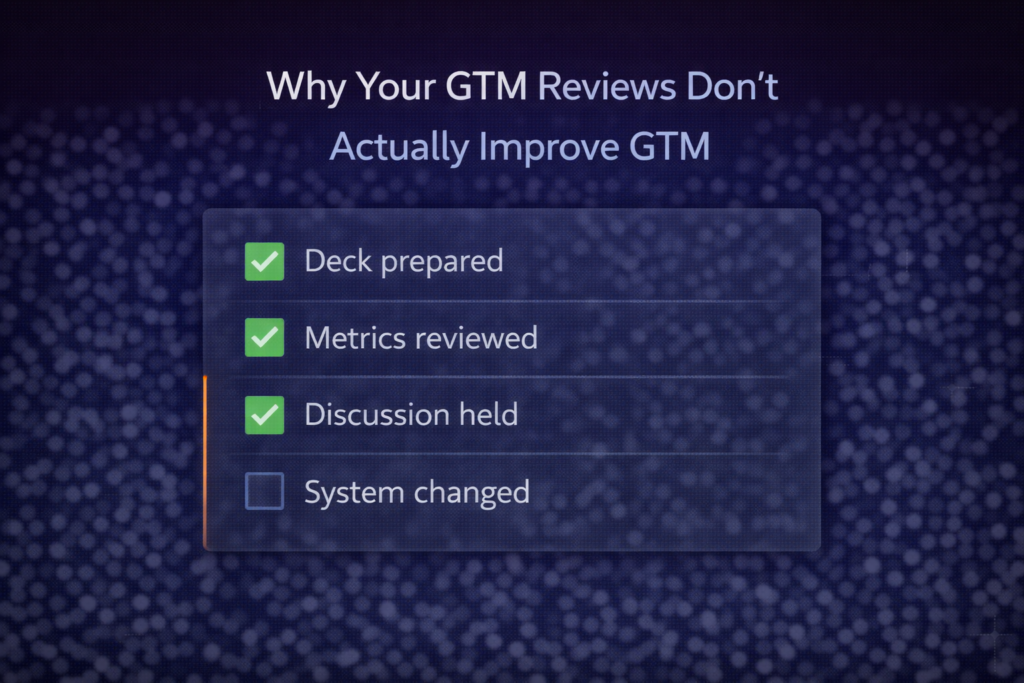
Most GTM teams review a lot.
Pipeline reviews.
Deal reviews.
Forecast calls.
QBRs.
Calendars are full.
Slides are polished.
And somehow… the same problems show up next month.
That’s because most GTM reviews aren’t designed to improve GTM.
They’re designed to explain results.
Traditional GTM reviews focus on:
- What closed
- What slipped
- What’s at risk
- Who needs to “do more”
Useful for accountability.
Terrible for learning.
They tell you what happened, not why it keeps happening.
If you want GTM to improve, reviews need to answer different questions:
- Which signals actually predicted success?
- Which segments behaved differently than expected?
- Where did reps override the system — and why?
- What assumptions turned out to be wrong?
Most reviews never get there.
They stop at performance, instead of interrogating the system that produced it.
This is where CROs and RevOps often talk past each other.
CROs want confidence in the number.
RevOps wants confidence in the data.
What’s missing is a shared space to examine decision quality.
Not:
“Did we hit target?”
But:
“Did our GTM motion behave the way we expected it to?”
In high-functioning teams, GTM reviews look different.
They’re explicit about:
- what was tested
- what changed
- what signals were monitored
- what broke the model
They separate:
- execution problems from
- design problems
And they treat the latter as first-class citizens.
In my GTM work, the biggest unlock often comes from reviewing the system, not the people.
When teams shift from:
“Why didn’t reps follow the process?”
to:
“Why didn’t the process help the reps?”
Everything gets more productive.
Less defensiveness.
More insight.
Better iteration.
A simple litmus test for your next GTM review:
👉 Did this meeting change what you’ll do next week?
If not, it wasn’t a review, it was a report-out.
Next edition: why velocity isn’t about speed… it’s about feedback.