
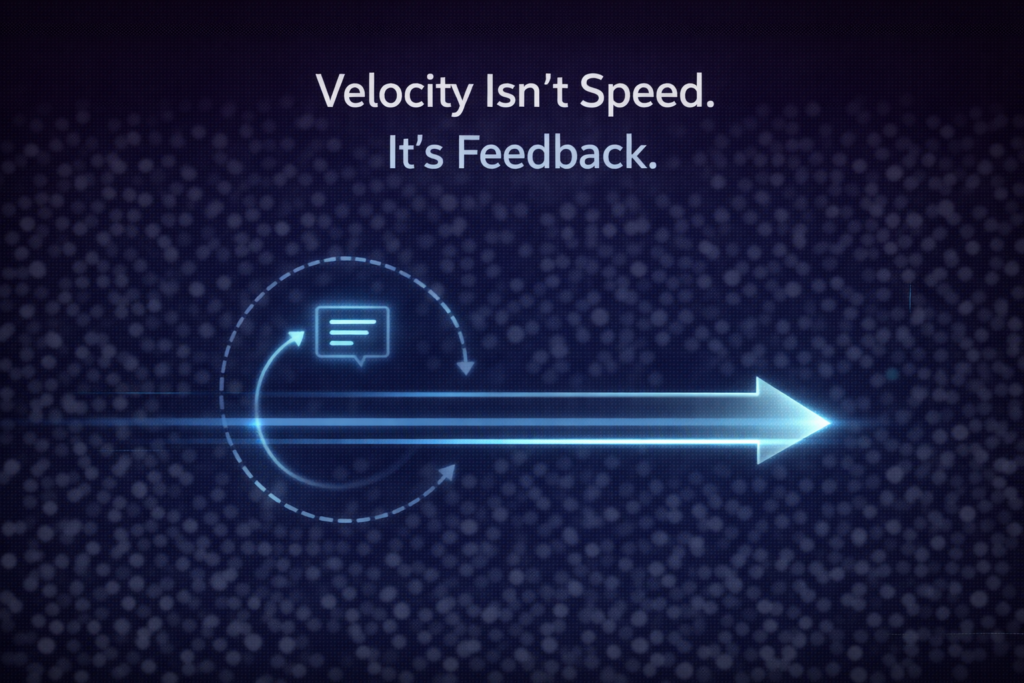
When GTM leaders talk about velocity, they usually mean speed.
More meetings booked.
Faster deal cycles.
More activity per rep.
That’s motion, not velocity.
Real velocity is how quickly your GTM motion learns.
Speed asks:
- How fast are reps moving?
- How many touches are we sending?
- How quickly are deals progressing?
Feedback asks:
- How fast do we know something isn’t working?
- How quickly can we adjust targeting, timing, or messaging?
- How long does it take to turn a signal into a decision?
Only one of those actually improves GTM.
This is where many teams get stuck.
They increase activity to feel momentum, but slow down learning at the same time.
Why?
- Too many experiments running at once
- No clear hypothesis per change
- No signal-level feedback loops
- No ownership of “what did we learn?”
More motion. Less clarity.
High-velocity GTM teams behave differently.
They optimize for short feedback cycles, not raw speed:
- Small, controlled changes
- Clear success and failure criteria
- Early signal detection
- Fast rollback when assumptions break
RevOps provides the measurement backbone.
GTM engineering wires feedback directly into workflows.
Together, they reduce decision latency.
That’s real velocity.
In practice, this often means doing less:
- Fewer segments tested at once
- Fewer variables changed simultaneously
- Fewer dashboards, more alerts
- Fewer meetings, more conclusions
The goal isn’t to move faster.
It’s to find out sooner.
Here’s a simple diagnostic you can use this week:
👉 How long does it take your team to realize a GTM assumption was wrong?
Days?
Weeks?
A full quarter?
That answer tells you far more about GTM health than activity metrics ever will.
Next edition: a practical test to tell whether your GTM is actually getting better, or just busier.