
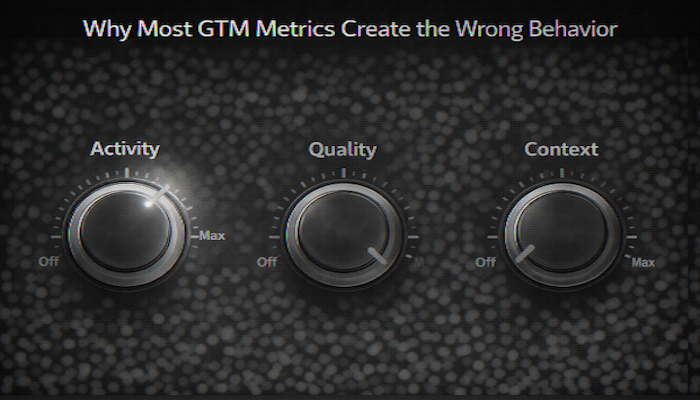
Metrics are not neutral. They steer behavior, whether you intend them to or not.
Activity metrics are a classic example.
They answer:
- How many calls?
- How many emails?
- How many touches?
They’re easy to track.
They’re comforting to review.
And they quietly reward motion over judgment.
When teams are measured on activity:
- reps send more, not better
- managers coach effort, not decisions
- systems optimize throughput, not relevance
The metric is doing its job… just not the one you wanted.
High-performing GTM teams treat metrics as steering mechanisms, not scorecards.
They ask:
- What behavior does this metric encourage?
- What decision does it make easier?
- What would break if we removed it?
If a metric doesn’t improve decision quality, it’s usually noise.
In my GTM Engineering work, one of the fastest improvements comes from removing metrics, not adding them.
Clarity increases.
Focus returns.
Behavior changes.
A reframing that helps:
Don’t ask “What should we measure?”
Ask “What decision should this metric help us make?”
If you can’t answer that cleanly, the metric probably doesn’t belong.