
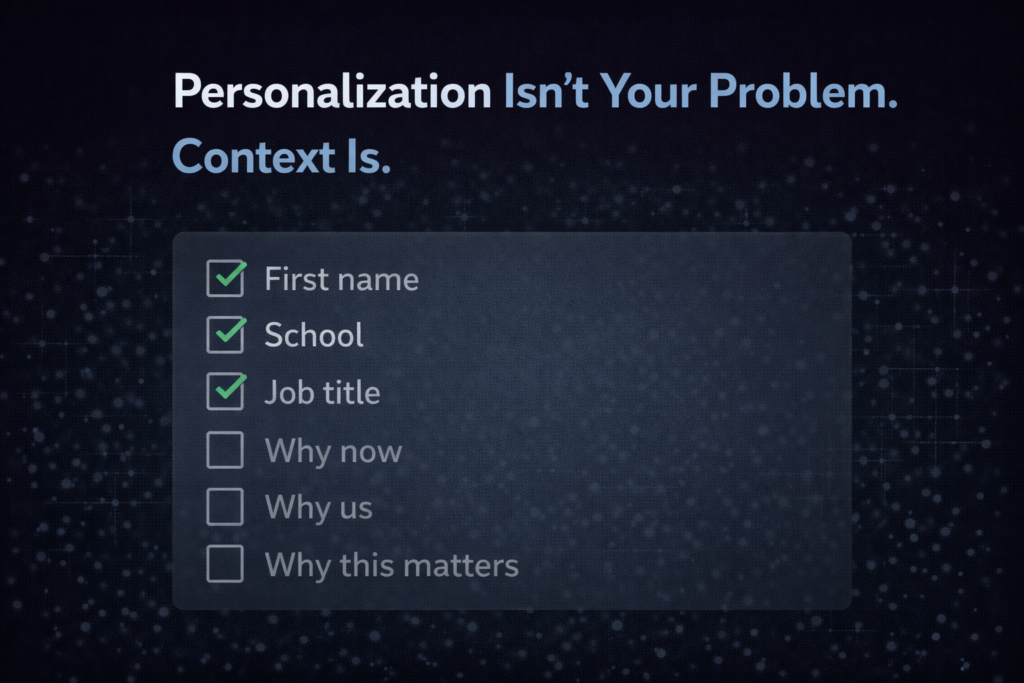
Let’s talk about personalization. Specifically, the kind that starts with:
“Saw you went to UCLA…”
Congrats. So did 90,000 other people. I still don’t know why you’re emailing me.
This is where a lot of GTM teams get stuck. They assume low reply rates mean:
“We need better personalization.”
So they:
- Add more variables
- Generate longer openers
- Let AI compliment people more creatively
And somehow… it gets worse.
Here’s the uncomfortable truth: Most personalization is just trivia. It’s accurate, but irrelevant. And relevance beats clever every time.
Mentioning my school, my job title, or my company tagline doesn’t tell me:
- Why this matters now
- What changed
- Why I should care today instead of six months ago
In SalesMint projects, we see this constantly. Teams spend weeks perfecting openers, before locking down segmentation, research, or timing.
Once we flip that order, something interesting happens.
When outreach is triggered by:
- A real account change
- A narrow segment with shared pain
- A signal that suggests urgency
The message almost writes itself.
At that point, personalization isn’t about being clever — it’s about responding to context that already exists.
This is why top reps don’t sound “personalized.” They sound aware.
They’re not saying:
“I noticed X about you.”
They’re saying (implicitly):
“I understand what just changed and why it matters.”
Huge difference.
So if your team is debating subject lines again, here’s a test:
Ask:
- Do we know who actually fits?
- Do we know what just changed?
- Do we know when it’s worth interrupting someone?
If the answer is no, rewriting the opener won’t save you.
Curious:
- What’s the worst “personalized” email you’ve ever received?
- And what’s one that actually made you reply?
Reply and tell me. I’m collecting examples.
Next edition, I’ll cover why more data doesn’t help unless it’s the right data (and how teams accidentally drown themselves in it).