
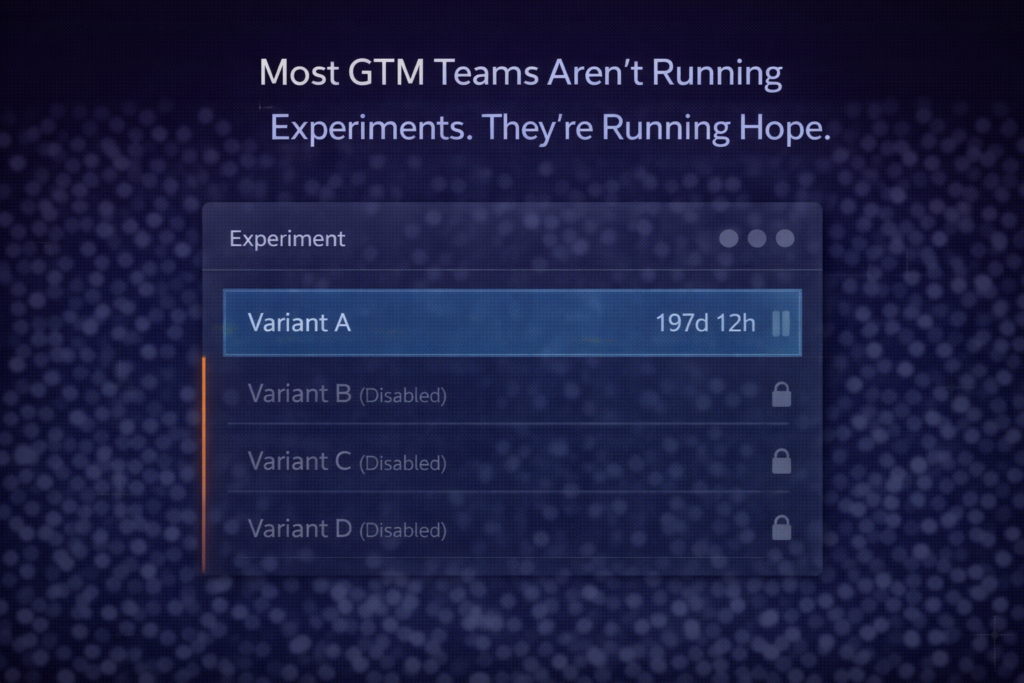
Everyone says they’re “experimenting.”
New sequences.
New segments.
New tools.
New messaging.
Activity everywhere.
Learning… not so much.
Here’s the uncomfortable truth:
Most GTM teams are not running experiments.
They’re running hope.
Hope that volume will fix relevance.
Hope that tools will fix prioritization.
Hope that next quarter will look better than the last.
An experiment has three things:
- A hypothesis
- A controlled change
- A way to tell if it worked
Most GTM motions skip straight to step four:
“Let’s try this and see.”
That’s not experimentation.
That’s motion.
When GTM is treated like a plan, teams ask:
- Did pipeline go up?
- Did revenue close?
- Did activity increase?
Those are outcomes, not learning signals.
When GTM is treated like an experiment, teams ask:
- What changed buyer behavior?
- Which signals actually mattered?
- What did we learn this week that changes next week?
Very different posture.
This is where CROs and RevOps either unlock leverage or stall it.
RevOps already owns:
- data integrity
- definitions
- measurement
GTM engineering augments that by:
- encoding hypotheses into workflows
- making changes deliberate
- surfacing feedback quickly
Together, they turn GTM from a guessing game into a learning system.
In practice, the shift is subtle but powerful:
- fewer simultaneous changes
- clearer “what we’re testing”
- explicit success and failure criteria
- fast rollback when something doesn’t work
Less chaos.
More clarity.
A simple diagnostic:
👉 If I asked your team what they learned about buyers last week, could they answer clearly?
If not, GTM isn’t experimenting yet.
Next edition: why most GTM reviews feel busy, yet still fail to improve anything.