
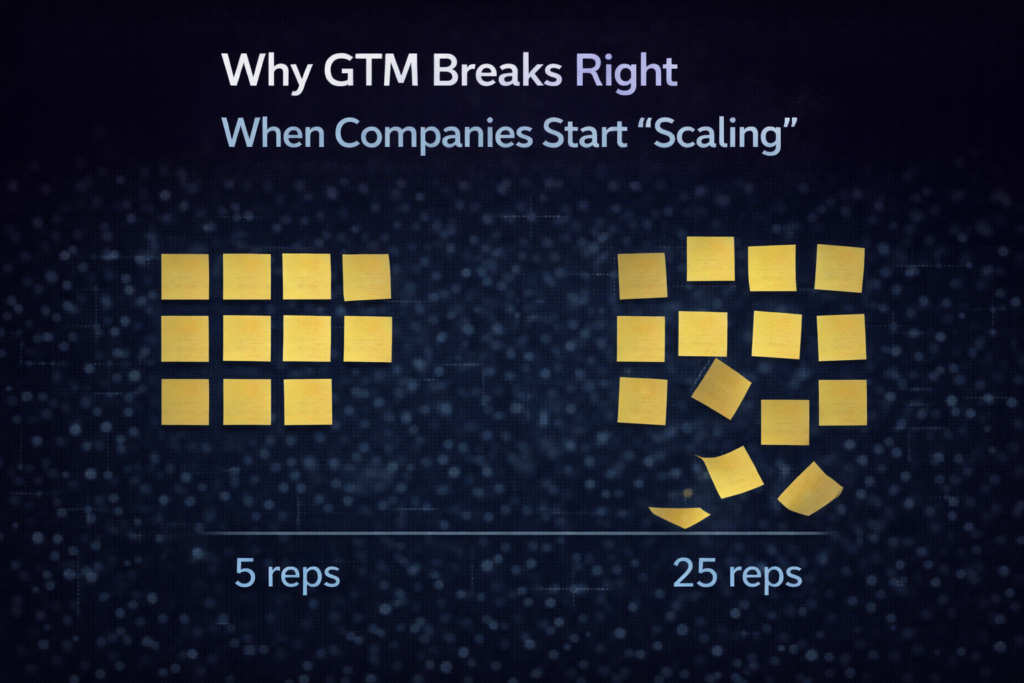
There’s a strange moment most companies hit around early scale.
Revenue is growing. Headcount is increasing. The stack looks “grown up.”
And yet… everything feels harder.
Pipeline gets noisier. Forecasts feel shakier. Reps complain more. RevOps is suddenly overwhelmed.
This is usually when leaders say:
“We need more process.”
What they actually need is better system design.
What worked at $1–3M ARR was informal and human:
- Reps knew every account
- Research happened naturally
- Signals were spotted manually
- Context lived in people’s heads
At scale, that breaks.
Not because the team got worse, but because tacit knowledge never got encoded.
This is where GTM engineering quietly enters.
Not as a new org chart box, but as a capability that helps RevOps do what it’s already responsible for:
- standardizing decision logic
- operationalizing best practices
- reducing manual judgment calls
The goal isn’t control. It’s continuity.
In SalesMint work, we often see this inflection point clearly. RevOps is doing the right things:
- cleaning data
- managing tools
- maintaining CRM hygiene
But no one is translating how great reps actually operate into systems.
That gap is what breaks GTM at scale.
Scaling doesn’t fail because teams lack discipline. It fails because systems didn’t mature with the business.
Next edition: why reps resist “good systems” and why that’s actually useful information.